Japan Markets ViewQUICK Monthly Survey: Nikkei 225 Forecast Shifts Downward for the First Time in Two Months as AI and Semiconductor Stocks Test Rebound
Nov 17, 2026

[Yosuke Oyake, QUICK Market Eyes] QUICK Monthly Survey: Nikkei 225 Forecast Shifts Downward for the First Time in Two Months as AI and Semiconductor Stocks Test Rebound In the QUICK Monthly Survey (Equity) for November, released by QUICK on November 9, the Nikkei 225 forecast by market participants for one month ahead shifted significantly downward to JPY63,376 from JPY69,813 in the previous survey. This marks the first downward shift in two months. The Nikkei 225 began showing stronger signs of a correction around mid-October. On November 6, the index plunged JPY3,643 – its third-largest point drop in history – falling into the JPY57,000 range. Credit concerns surfaced over an emerging US artificial intelligence (AI) cloud company, alongside caution over policy trends regarding AI investment following the US midterm elections. Against this backdrop, AI- and semiconductor-related stocks, which had previously led the market, plummeted, rapidly cooling investor sentiment. However, signs of a rebound appear to be emerging recently for these stocks, as investors begin to view their valuations as attractive.
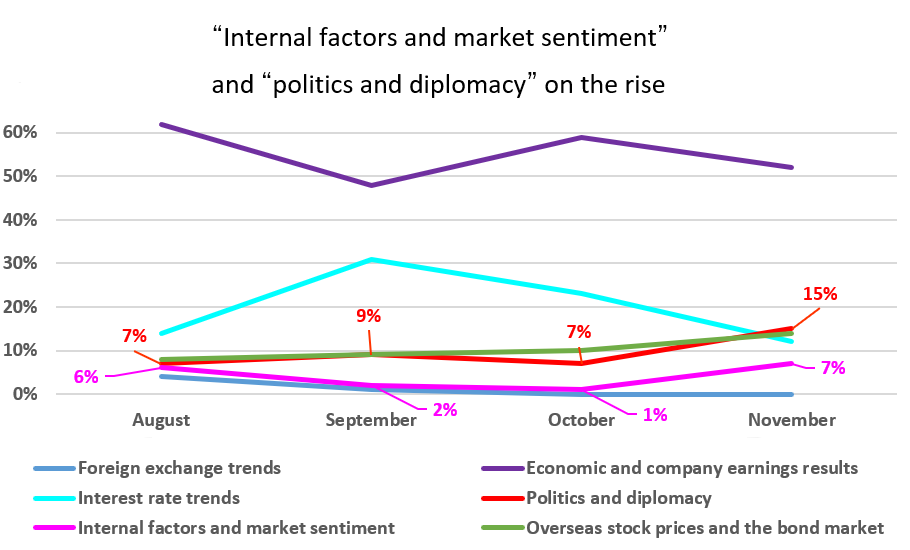
The survey was conducted from November 2 to 5. Responses were obtained from a total of 109 individuals, including those from securities firms and asset management companies. Regarding the most closely watched factors driving stock price volatility over the next six months, “Economic and company earnings results” fell from 59% in the previous month to 52%, while “Interest rate trends” declined from 23% to 12%. On the other hand, “Politics and diplomacy” more than doubled from 7% to 15%. “Internal factors and market sentiment” rose from 1% in the previous month to 7%, reaching its highest level in four months since July (8%). Following the Democratic Party’s landslide victory in the US midterm elections, uncertainty over the outlook for US politics, including moves toward data center regulations, appears to be dampening investor sentiment.
The Nikkei 225 reclaimed the milestone JPY70,000 level in early October. However, the index fell to JPY63,290 by the end of the month amid concerns over the monetization of AI investments and credit anxieties surrounding US-based CoreWeave. In November, selling in high-tech stocks accelerated as investors grew cautious about data center regulations after the Democratic Party won control of both chambers of Congress in the US midterm elections. On November 6, the index posted its third-largest drop on record, falling more than 20% from its record high of JPY72,366 reached in June and entering a “bear market.” Although momentum for a rebound has emerged after the initial wave of selling ran its course, risk aversion has intensified among investors battered by the sharp stock plunge. This shift is also reflected in sector-specific investment stances. The proportion of respondents planning to “overweight” the “Electronics & Precision Machinery” sector, which includes high-tech stocks, plummeted from 59% in the previous survey to 17%. Conversely, the figure for the defensive “Pharmaceuticals & Foods” sector rose from 0% to 17%.
Caution Over “Reverse Rotation Risk in AI Investment”
The sharp market correction was triggered by the risk of a reversal in AI investment stemming from the midterm election results. Following Democratic victories in gubernatorial elections in states such as Texas – a major hub for data centers – concerns have grown over tighter state-level environmental regulations and temporary construction halts. If construction fails to proceed as planned, the virtuous cycle that has lifted the broader economy through demand for semiconductors, electric power, and construction machinery could break down. Some market participants warn that the resulting negative impact on the overall economy could become too significant to ignore.
The key focus going forward will be whether AI-related stocks enter a phase of testing a rebound. In the latest survey, forecasts for the Nikkei 225 fell from the previous survey in October to JPY65,497 for three months ahead, JPY67,278 for six months ahead, and JPY69,740 for one year ahead (compared with JPY70,742, JPY72,077, and JPY74,274, respectively). Nevertheless, a gradual upward trajectory remains intact. One respondent from an asset management company noted, “Currently, following the Democratic victory, tighter regulations on AI investment are being viewed as a negative factor, and panic-like selling by funds is also being seen. However, we expect this selling pressure to gradually ease and the stock market to head toward a rebound as supply and demand conditions stabilize.” In a special question asking about the impact of credit concerns surrounding CoreWeave, 53% of respondents answered that “selection between strong and vulnerable companies has begun even within the AI sector.” Only 5% held the view that “the AI bubble has begun to burst and the market is entering a prolonged correction phase.” This suggests that most market participants believe the market has shifted to a phase of selective differentiation within the AI and semiconductor sectors.
There are also catalysts supporting expectations for a recovery. In terms of valuation, the forward P/E ratio of the SOX – which comprises major semiconductor stocks – has fallen to its lowest level since 2023 following the sharp drop in related stocks. As a result, some observers note that concerns over the overvaluation of US equities as a whole have receded significantly. Furthermore, CoreWeave – which originally sparked the profitability concerns – reported earnings for the July-September 2026 quarter on November 10 that beat market expectations. This helped restore buying confidence in AI-related stocks, with the SOX surging 5.65% in the US stock market on November 11 and rapidly recouping the sharp losses incurred immediately after the midterm elections. During the week of November 16, US AI developer Anthropic is scheduled to hold its IPO. Anthropic’s listing is set to be one of the largest IPOs in history by funds raised. If strong investor buying appetite is confirmed for the offering, investor sentiment could improve. As such, the event is drawing close attention as a litmus test for whether the AI-driven market rally can regain its momentum.
(Reported on November 13, 2026)
Related dataset – QUICK Monthly Survey
https://corporate.quick.co.jp/data-factory/en/product/data012/
Related article –QUICK Monthly Survey: Nikkei 225 Forecast Shifts Upward for the First Time in Three Months as Focus Centers on Economic and Company Earnings Results
Disclaimer
https://corporate.quick.co.jp/en/terms/#disclaimer
Follow us on LinkedIn to stay updated with Japan Markets.