Japan Markets ViewQUICK Monthly Survey: Nikkei 225 Forecast Shifts Upward for the First Time in Three Months as Focus Centers on Economic and Company Earnings Results
Oct 26, 2026

[Yosuke Oyake, QUICK Market Eyes] In the QUICK Monthly Survey (Equity), released by QUICK on October 13, the Nikkei 225 forecast by market participants for one month later (late October) shifted upward for the first time in three months to 69,813. On October 6, the Nikkei 225 recovered to the 70,000 level for the first time in about three months. However, the index subsequently underwent a sharp correction, driven partly by concerns over the profitability of investments related to artificial intelligence (AI). Still, major companies are scheduled to announce their financial results for the July-September period of 2026 starting in late October. Some market participants note that the recent decline represents “a wait-and-see attitude and adjustment ahead of earnings announcements.” Strong corporate earnings and sector rotation are expected to support the market. The Nikkei 225 will hopefully test its recovery again.
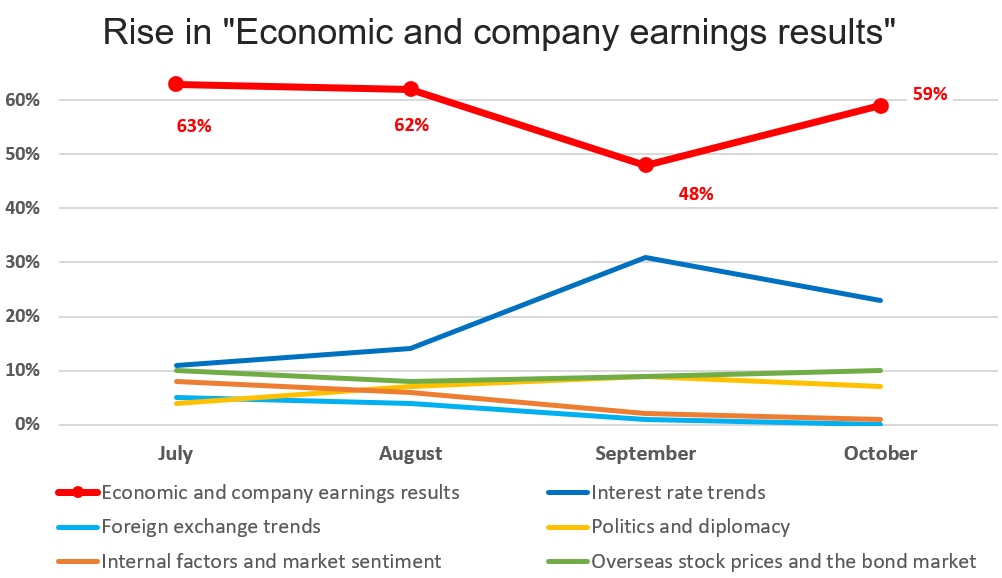
The survey was conducted from October 6 to 8. Responses were obtained from a total of 106 individuals, including those from securities firms and investment management companies. In a question about the most closely watched factors driving stock price volatility over the next six months, “Economic and company earnings results” rose significantly to 59% from 48% in the previous survey. Meanwhile, “Interest rate trends” fell to 23% from 31%. Following the Bank of Japan’s Monetary Policy Meeting in September, the market has increasingly priced in rate hikes at a pace of “once every three months.” At the same time, the recent upward trend in interest rates appears to be slowing, suggesting that excessive caution regarding interest rate trends has eased. Ahead of the full-fledged earnings season, market focus appears to be shifting toward corporate earnings trends.
Although the Nikkei 225 recovered to the 70,000 level on October 6 for the first time in about three months, subsequent adjustments progressed due to profit-taking and concerns over AI-related investments. On October 15, the index temporarily plunged by more than 3,500, falling below 65,000. The trigger was a sharp decline in corporate bond prices of CoreWeave, a US AI startup. As investors grew more risk-averse, panic selling mounted, centered on AI-related stocks. Still, many market participants note that market fundamentals themselves are not bad. In September, SMBC Nikko Securities revised its fiscal 2026 net profit forecast for major companies upward by 5.8 points from its previous estimate, to a 28.8% year-on-year increase. Responses were gathered before the major adjustment in the Nikkei 225. However, in a question regarding investment stances by sector, the proportion of respondents planning to overweight “Electronics & Precision Machinery” – which includes AI and semiconductors – surged to 59% from 19% in the previous survey. Expectations for earnings performance in related stocks remain strong.
TOPIX Remains Relatively Firm
The relative resilience of the TOPIX compared with the Nikkei 225 is also expected to provide support. Comparing the index performance from October 6, when the Nikkei 225 hit its recent high, to October 15, the Nikkei 225 fell by more than 8%, while TOPIX declined by only 4%. On October 15, more than 30% of the stocks listed on the TSE Prime Market advanced. Strategists noted that capital was not leaving the market but was instead shifting to value and defensive stocks as a destination for funds outside AI-related stocks. Buying interest in value and defensive stocks with strong earnings prospects is likely to support the market.
Major Japanese and US companies, including US hyperscalers, are scheduled to announce their financial results starting in late October. The key focus will be whether concerns over reduced investment in AI-related areas and profitability can be dispelled. In addition, the US midterm elections are slated for November 3. In response to a question regarding the impact of the election results on Japanese stocks, the most common response was “Neutral” at 68%, regardless of the outcome. Still, market anomalies suggest that concerns about the political outlook tend to ease once the midterm elections are over, making US stock prices more prone to rise. Japanese stocks have recently fallen sharply amid concerns about AI-related stocks. However, expectations for strong corporate earnings and a post-election rally are hoped to test a recovery.
(Reported on October 16, 2026)
Related dataset – QUICK Monthly Survey
https://corporate.quick.co.jp/data-factory/en/product/data012/
Related article – QUICK Monthly Survey: Nikkei 225 Forecasts Shift Downward for 2 Consecutive Months – Interest Rate Tolerance of Japanese Stocks Tested
Disclaimer
https://corporate.quick.co.jp/en/terms/#disclaimer
Follow us on LinkedIn to stay updated with Japan Markets.