
Japan Markets ViewQUICK Monthly Survey: Nikkei 225 Forecasts Shift Downward for 2 Consecutive Months – Interest Rate Tolerance of Japanese Stocks Tested
Sep 25, 2026

[Yosuke Oyake, QUICK Market Eyes] The QUICK Monthly Survey (Equity), released by QUICK on September 7, shows that market participants forecast the Nikkei 225 to be 65,680 in one month. This represents a downward shift from 65,805 in the previous survey. The result marked the second consecutive month of a decline from the previous survey. The Nikkei 225 reached a record high of 72,366 on June 25. However, it was subsequently forced into a major correction down to the 61,000 range toward late July. Although the index later rebounded and maintained some resilience, ongoing upward trends in interest rates weighed on the market. Yields on 10-year Japanese government bonds (JGBs) reached their highest level in roughly 30 years. Market participants are now focusing on the outlook for future interest rates and the interest rate tolerance of Japanese stocks.
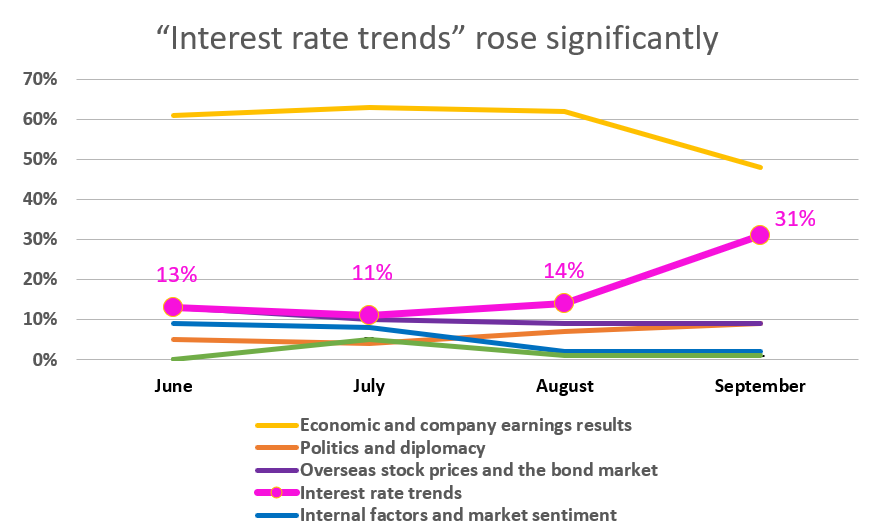
The survey was conducted from September 1 to 3. Responses were obtained from a total of 111 individuals, including those from securities firms and investment management companies. In a question about the most closely watched factors driving stock price volatility over the next six months, “Economic and company earnings results” declined sharply to 48% from 62% in the previous survey. The figure marked the lowest level in five months since April. On the other hand, “Interest rate trends” rose significantly to 31% from 14% in the previous survey. This was the highest level in three years and eight months since January 2023 at 31%.
On September 2, yields on newly issued 10-year JGBs, a benchmark for long-term interest rates, temporarily rose to 3.015%, reaching their highest level in roughly 30 years. Generally, rising interest rates are considered negative for stock prices through increased corporate borrowing costs and reduced relative investment appeal in terms of earnings yield. One market participant noted, “It is difficult to envision a scenario where interest rates drop significantly. However, it is entirely plausible that they will remain hovering around 3% for some time.” Speculation is spreading that the Bank of Japan (BOJ) may accelerate the pace of its interest rate hikes. Amid this backdrop, investors are exhibiting a cautious stance as they attempt to gauge the future ceiling for interest rates.
In a question asking about the impact of rising Japanese long-term interest rates on the stock market, the most common response at 38% was, “The impact on the stock market is limited, as some sectors such as banking stocks benefit.” This was followed by “At current interest rate levels, stock prices will continue to rise” at 31%. Responses stating, “Concerns over fiscal deterioration are the main background factor, making this negative for the stock market,” stood at 14%. Overall, responses viewing rising interest rates as negative for stock prices remained around 30%. This indicates that market participants currently do not expect higher rates to exert major downward pressure on equities.
When analyzing the relationship between equities and interest rates, one useful benchmark is the “Domar condition.” Under this condition, fiscal sustainability is maintained, and the government debt-to-GDP ratio remains stable as long as the nominal gross domestic product (GDP) growth rate exceeds long-term interest rates. On September 8, the Cabinet Office announced that nominal GDP growth for the April-June 2026 quarter was 5.5% on a seasonally adjusted, annualized quarter-on-quarter basis. This figure exceeds the current long-term interest rate level of 3%.
Long-term interest rates in Japan have risen by 1.4 points in roughly one year. They increased from the 1.6% range in October 2025, when the administration of Sanae Takaichi took office, advocating “responsible and proactive public finances.” Stock prices have risen, supported by the administration’s growth strategy. Consequently, the Domar condition readily comes into focus as a crucial criterion for assessing fiscal sustainability and determining whether growth-oriented investments will lead to actual economic expansion.
In response to a question regarding the expected peak for 10-year JGB yields, “3.0% to 3.5%” was the most common answer at 62%. The recent rise in interest rates is primarily attributed to concerns over fiscal deterioration and inflation stemming from instability in the Middle East. However, as the current Domar condition indicates, the prevailing market view interprets this trend overall as a “good rise in interest rates” stemming from economic growth. In fact, one market participant remarked, “If the rise in US long-term interest rates pauses, a rate rise toward 3% in Japan will be tolerated, allowing Japanese stocks to rise.”
However, responses predicting “3.5-4.0%” accounted for 32%. Few statistical indicators currently show clear negative impacts from higher interest rates on areas such as corporate capital expenditure plans or personal consumption expenditures. Nevertheless, if rate hikes persist, risks to the real economy cannot be ruled out. These include reduced capital investment, declining housing investment, and an increase in corporate bankruptcies due to deteriorating cash flows. In a question regarding investment stances by sector, the proportion of respondents planning to underweight “Construction & Real Estate” – a sector facing headwinds from rising rates – surged from 11% in the previous survey to 23%. This clearly reflects growing market caution in certain areas.
At the BOJ Monetary Policy Meeting scheduled for September 17-18, a policy rate hike from the current 1.0% to around 1.25% is widely viewed as a certainty. Market attention is now shifting toward the future pace of rate hikes and the terminal rate (the final peak of the policy rate). Depending on the Takaichi administration’s fiscal policies and developments in the Middle East, the pace of rate hikes could accelerate faster than market expectations. Indeed, one strategist noted, “Long-term interest rates could potentially rise to around 4%.” If interest rates continue to climb, there is a risk that the Domar condition could deteriorate. Consequently, market participants need to prepare for scenarios in which higher rates become a heavy burden on stock prices. (Reported on September 11, 2026)
Related dataset – QUICK Monthly Survey
https://corporate.quick.co.jp/data-factory/en/product/data012/
Related article – QUICK Monthly Survey: Nikkei 225 Forecast Shifts Downward Significantly, but Expectations of Future Rises Remain Strong
Disclaimer
https://corporate.quick.co.jp/en/terms/#disclaimer
Follow us on LinkedIn to stay updated with Japan Markets.