
Japan Markets ViewQUICK Monthly Survey: Nikkei 225 Forecast Shifts Downward Significantly, but Expectations of Future Rises Remain Strong
Aug 21, 2026

[Yosuke Oyake, QUICK Market Eyes] The QUICK Monthly Survey (Equity), released by QUICK on August 10, shows that market participants forecast the Nikkei 225 to stand at 65,805 one month on. This represents a significant downward shift from 70,031 in the previous survey. Since July, the Nikkei 225 has undergone a correction, driven mainly by artificial intelligence (AI) and semiconductor-related stocks. The drop from the record high of 72,366 set on June 25 to the recent low of 61,434 recorded on July 29 amounted to 10,932 (down 15.1%). However, the Nikkei 225 is currently on a recovery track. It has climbed back to near the level of a two-thirds retracement of the decline from its high to its recent low. The announcement of financial results for the April–June quarter of 2026 by major companies has run its course. Strategists have characterized the results as “generally solid,” and there is a prevailing view that the economic fundamentals remain sound. This suggests that market participants’ expectations for future gains remain strong.
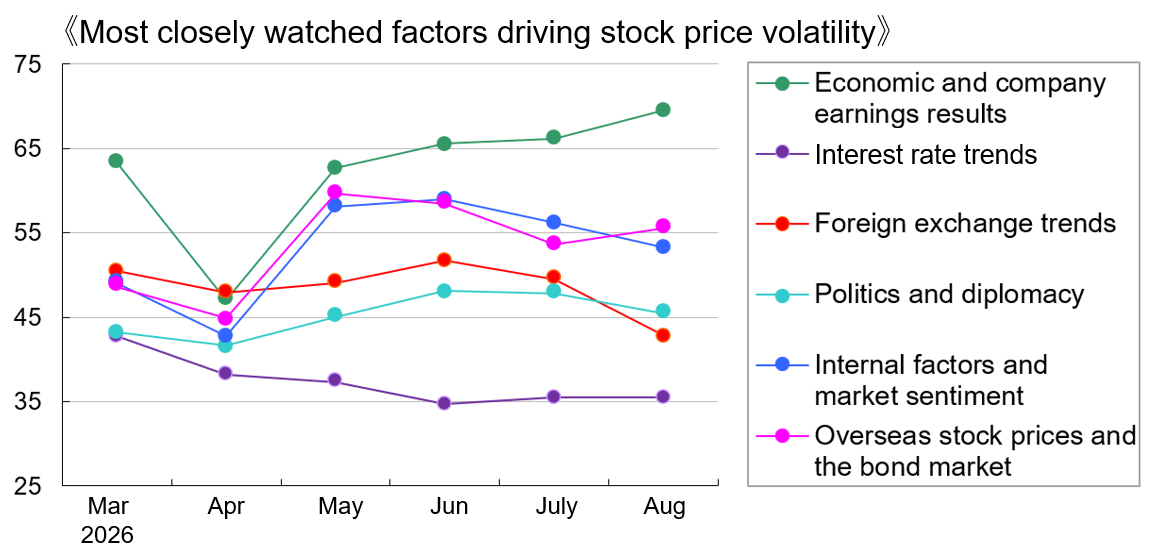
The survey was conducted from August 4 to 6. Responses were obtained from a total of 114 individuals, including those from securities firms and investment management companies. In a question about the most closely watched factors driving stock price volatility over the next six months, the response “Interest rate trends” rose 3 points to 14%, up from 11% in the previous survey. This was the highest level in eight months since December 2025, when it was at 16%. The shift appears to reflect concerns among market participants over rising long-term interest rates driven by factors such as fiscal worries associated with the Takaichi administration’s “Japan Growth Strategy” and the cabinet decision on the “Basic Policy on Economic and Fiscal Management and Reform (‘Big-Boned’ policy guidelines).”
Meanwhile, the response “Economic and company earnings results” fell 1 point to 62% from the previous 63%. However, the Economic and Corporate Earnings Index—which measures the strength of the impact on the stock market, reached 69.5, the highest level in eight years and six months since February 2018 (74.0). On this scale of 0 to 100, 0 represents the strongest concern as a downward factor, while 100 represents the strongest expectation as an upward factor. This indicates a heightened interest among market participants in the April–June financial results of major companies. Such interest is key to gauging the potential room for a stock price recovery following the round of adjustments.
From late June to late July, the Nikkei 225 was forced into a major adjustment. One reason was growing concern over the monetization of massive AI capital expenditures by hyperscalers. On July 22, U.S.-based Alphabet, the parent company of Google, announced its financial results for the April–June quarter of 2026. Although revenue growth exceeded market forecasts, its stock price plummeted amid caution over an upward revision to its capital expenditure outlook. Concerns over overinvestment spilled over into the Japanese market as well. Japanese AI and semiconductor-related stocks fell in tandem. In a question asking asset managers about their investment stance by sector, “Steel & Machinery,” which includes AI and semiconductor stocks, fell 12 points from 12% in the previous survey to 0%. Similarly, “Electronics & Precision Machinery” dropped 7 points from 46% to 39%.
Nevertheless, the financial results of major companies are generally strong. According to a compilation by The Nikkei, 70% of the 956 Prime Market-listed companies with a March fiscal year-end that announced financial results by August 10 saw profit increases in the April–June quarter. Earnings expanded across a wide range of industries, including semiconductor-related sectors, automobiles, electronic components, industrial machinery, and materials. Furthermore, the stock price adjustments toward the end of July are easing the sense of overheating in AI and semiconductor-related stocks. Kioxia Holdings (285A), which commands high market attention, announced its April–June financial results on July 31, showing a significant increase in both revenue and profits. The company stated that its consolidated net profit under IFRS for the July–September quarter is projected to reach JPY1.27 tn, a 31-fold increase year-on-year. Companies such as Advantest (6857) and Tokyo Electron (8035) raised their earnings forecasts for the fiscal year ending March 2027. The growth momentum of AI and semiconductor-related stocks has yet to slow down.
In the latest survey on the outlook for the Nikkei 225, the six-month forecast stood at 68,374 and the one-year forecast at 71,704. Both were revised downward slightly from the previous survey (71,179 for six months and 74,369 for one year). Even with this downward revision, market participants’ expectations of future price increases remain unabated. One respondent from an investment management company noted, “Stock prices are likely to undergo speed adjustments for a while due to the rapid pace of increases up to June. However, expectations regarding the Takaichi cabinet’s growth strategy, AI-driven productivity improvements, and consumption tax cuts remain strong. Consequently, stock prices are expected to turn upward again eventually.”
In a question regarding the medium- to long-term impact on the stock market of the “Big-boned Policy” approved by the Cabinet on July 31, the most common response, accounting for 39%, was: “It is a commendable growth strategy, but its impact on the stock market will be limited to specific sectors.” The next most common response was “It is premature to evaluate the growth strategy itself, and the strategy will have no major impact on the stock market,” at 31%. This was followed by “It is a commendable growth strategy that will have a positive impact on the stock market,” at 25%. These results highlight divided opinions regarding the outlook. Some market participants noted, “It cannot be evaluated until concrete actions are taken.” Many participants are taking a wait-and-see attitude wanting to evaluate the breakdown and effectiveness of the over JPY370 tn in cumulative public-private investments across 17 strategic fields proposed by the Takaichi administration as part of its growth strategy. The phase in which stock prices rise solely on expectations of the growth strategy has ended. It will likely be necessary to discern whether a wide range of companies— including AI and semiconductor-related firms that have driven the market so far—can achieve sustainable growth accompanied by monetization.
(Reported on August 14, 2026)
Related dataset – QUICK Monthly Survey
https://corporate.quick.co.jp/data-factory/en/product/data012/
Related article – QUICK Monthly Survey: Takaichi Admin Rated 63; Stock Rise Welcomed, but Caution over Yen, Interest Rates Lingers
Disclaimer
https://corporate.quick.co.jp/en/terms/#disclaimer
Follow us on LinkedIn to stay updated with Japan Markets.