
Japan Markets ViewRide-Hailing App GO (581A) Trains AI on Mobility Data With Eye on Autonomous Driving Era
Sep 09, 2026

[Chiaki Yumi, QUICK Market Eyes] Since its listing on the Growth Market in June 2026, the stock price of ride-hailing app service GO has been rising almost steadily after a round of profit-taking.
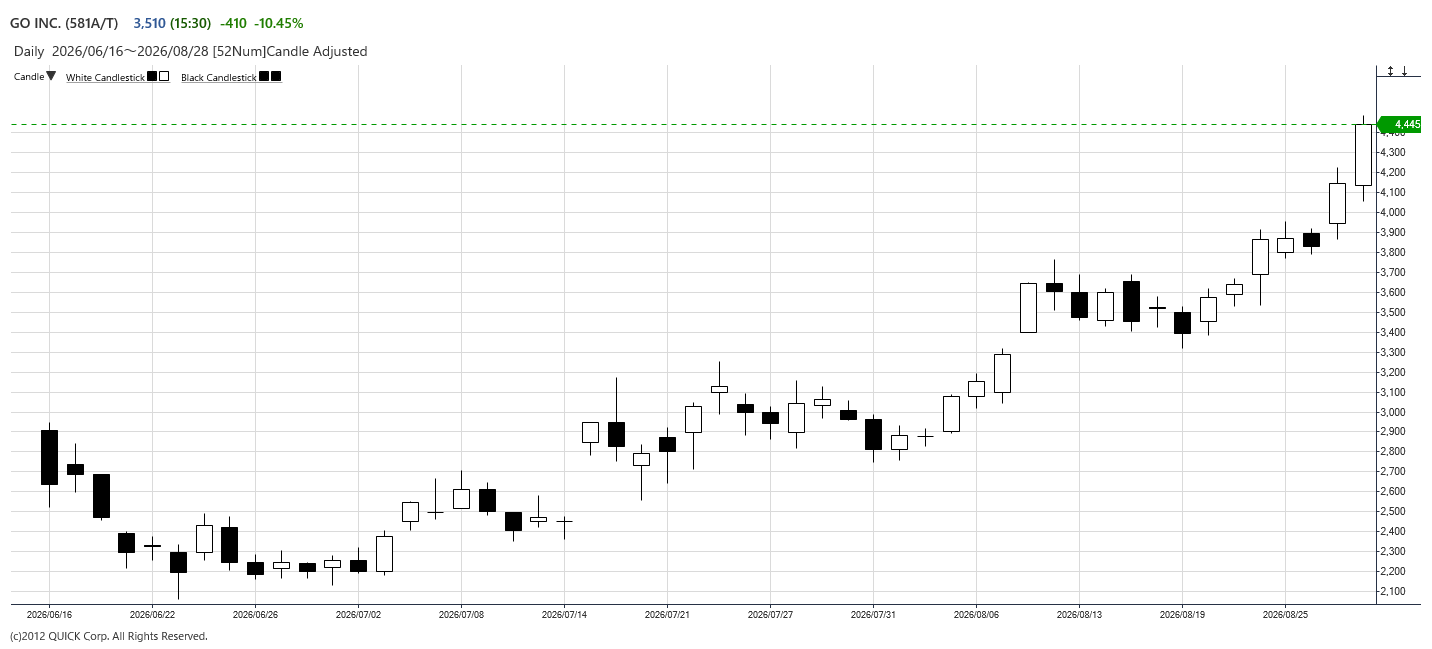
In addition to its recent strong financial performance, GO is improving the accuracy of supply and demand forecasting. The company achieves this by training AI on a vast amount of accumulated mobility data. As GO looks toward autonomous taxis in the future, expectations are growing for its potential. Market participants view the company as an entity that will establish a mobility platform for next-generation taxis through the integration of hardware and software.
Many people have likely experienced getting off at a train station only to find not a single taxi at the taxi stand, leaving them feeling lost. The convenience of the GO app lies in its ability to let users hail nearby taxis simply by entering their current location and destination. Passengers can also check the estimated arrival time for their taxi. This helps reduce their anxiety over not knowing when the vehicle will arrive. Meanwhile, taxi drivers can shorten their waiting time without having to drive around searching for passengers. This also increases vehicle utilization rates. For taxi driver jobs that involve a high level of discretion, this allows drivers to secure sales efficiently.
Thanks to this convenience, the app reached 35 million downloads as of February. The service area has also expanded to all 47 prefectures across Japan. However, the ride-hailing app usage rate in Japan remains at just 28%. Given that major cities outside of Japan reach 60% to 80%, there is still significant room for growth. In its corporate plan for the fiscal year ending May 2027, GO projects net sales of JPY48.5 bn (up 17% year-on-year) and operating profit of JPY13 bn (up 85% year-on-year). As the proportion of app-based dispatching increases, the number of completed rides – which represents the number of trips made through the app – is expected to grow.
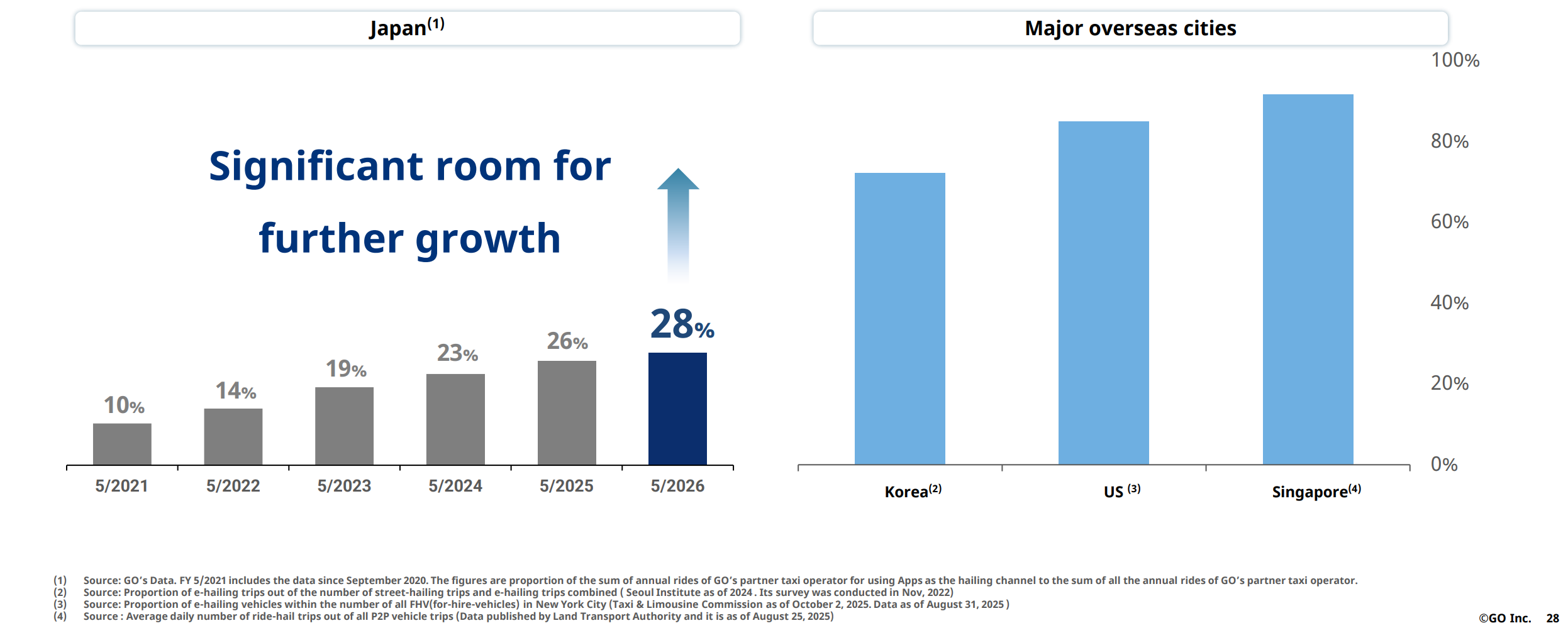
*Excerpted from GO’s financial results material for the fiscal year ending May 31, 2026.
The company collects fees from both users and taxi drivers as a result of successful matching.
Driven by fee revisions and the introduction of optional services, average revenue per completed ride is also expected to rise. The company’s core business includes taxi-related services. This segment provides equipment such as back-seat payment terminals and driver terminals. However, the highly profitable app-based dispatch business has substantial room for growth due to increasing usage and unit revenue. Consequently, profit growth is expected to continue outpacing sales growth.
Mobility Data Accumulation x AI
Supporting this convenience is highly accurate demand forecasting. Taxi demand involves a wide range of factors, including weather, events, calendar effects, and train operation status.
GO’s strength lies in predicting supply and demand in real time and utilizing these insights for vehicle dispatch. This capability is supported by AI- and algorithm-driven decisions, based on a rich accumulation of mobility data. Owning the data infrastructure essential for utilizing AI is another key strength of the company.
The autonomous driving field is where GO is likely to show its presence as a data company, beyond merely providing a ride-hailing services. GO is partnering with US autonomous taxi company Waymo and Nihon Kotsu. Together, they are working to implement autonomous taxis in Tokyo. When autonomous taxis become a reality, a platform capable of dispatching taxis to those in need in a timely and appropriate manner will be required. Human drivers can navigate based on their own judgment. In contrast, for autonomous taxis, a command system responsible for decisions such as choosing appropriate waiting areas becomes increasingly important. GO is also drawing attention as an entity that could serve as the control center for the era of autonomous taxis.
(Reported on September 3, 2026)
Discover datasets unique to the Japanese equity market
Visit QUICK Data Factory: https://corporate.quick.co.jp/data-factory/en/
Disclaimer
https://corporate.quick.co.jp/en/terms/#disclaimer
Follow us on LinkedIn to stay updated with Japan Markets.