
Japan Markets ViewQUICK Monthly Survey: Takaichi Admin Rated 63; Stock Rise Welcomed, but Caution over Yen, Interest Rates Lingers
Jul 22, 2026
[Yosuke Oyake, QUICK Market Eyes] In the QUICK Monthly Survey (Equity), released by QUICK on July 6, the Nikkei 225 forecasted by market participants for one month ahead stood at 70,031. This was a significant upward shift from the previous survey and marked the first time the index has reached the 70,000 level since the survey began. Since late June, correction phases in AI and semiconductor-related stocks have been noticeable in the Tokyo market. This trend has been in tandem with declines in these sectors in the U.S. and South Korea. However, some market participants noted, “The underlying trend of expanding demand itself remains unchanged, and stock prices will follow an upward trend.” The view that stocks centered on AI and semiconductor-related sectors will drive the rally remains strong. There is also high anticipation for the growth strategy proposed by the administration. On the other hand, the yen has weakened in the foreign exchange market since Prime Minister Sanae Takaichi took office, and long-term interest rates have also shown a clear upward trend. Under these circumstances, an increasing number of market participants appear to be cautious about the “market’s trust” in the Takaichi administration as implied by interest rate and currency trends.
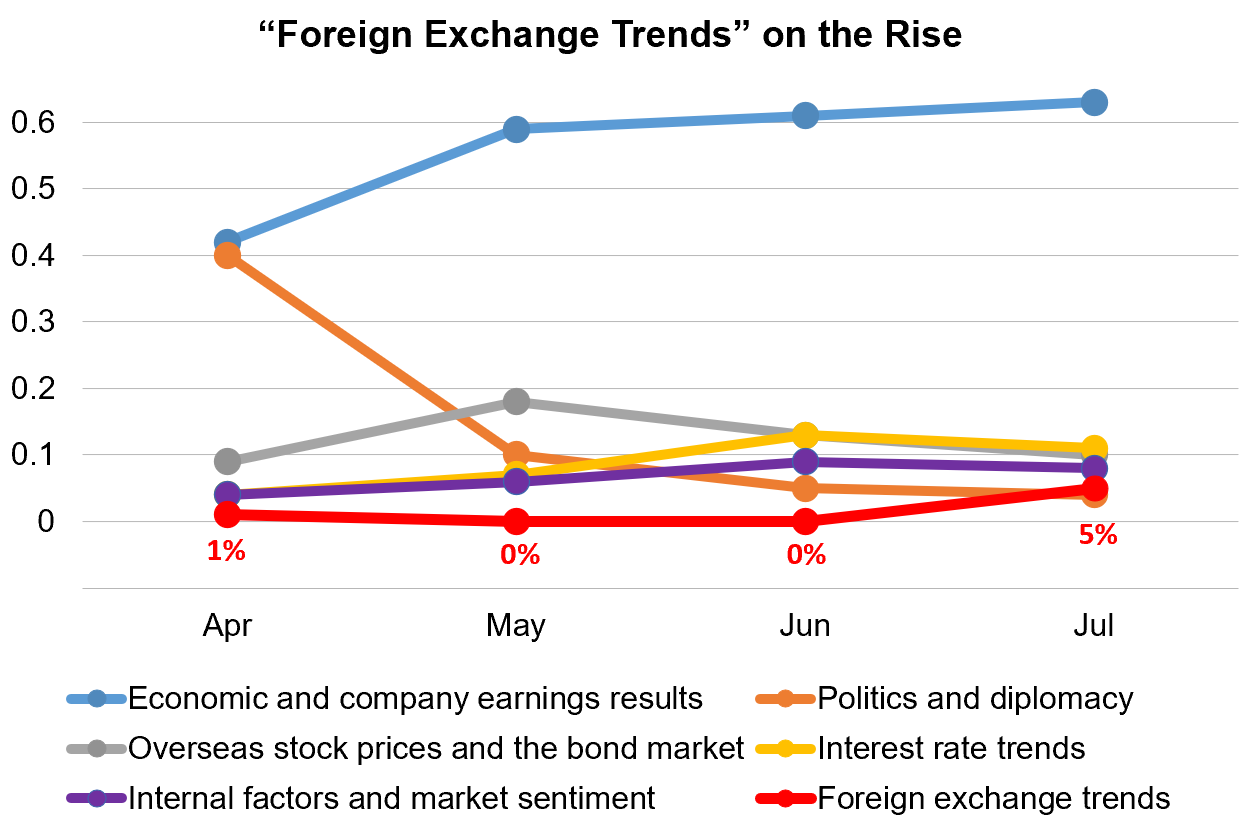
The survey was conducted from June 30 to July 2. Responses were obtained from a total of 114 individuals, including those from securities firms and investment trust management companies. In a question about the most closely watched factors driving stock price volatility over the next six months, “Foreign exchange trends” saw the largest increase. It rose to 5% from 0% in the previous survey, reaching its highest level in seven months since December 2025. “Interest rate trends” fell by two points to 11% from the previous survey (13%). However, it ranked as the second-highest factor overall, reflecting still-high interest in the market. This suggests that an increasing number of market participants are concerned about the impact of a weak yen and high interest rates on the stock market.
The results of the special question clearly highlighted both the persistent expectations for rising stock prices and the caution over exchange rates and interest rates. In this survey, respondents were asked to rate the Takaichi administration on a scale of 1 to 100, focusing on its economic policies. Although the simple average of the overall scores was 62.70 points, the median—representing the value in the middle when data is arranged in order—was 70 points. The mode, which represents the most frequent response, was 80 points. The median and mode significantly exceeded the simple average. Respondents who awarded high scores of 70 points or more formed the largest volume zone.
Behind these high ratings is the growth strategy fueled by the Takaichi administration’s proactive fiscal policy. Prime Minister Takaichi, who took office in October 2025, has advocated the theme of “responsible and proactive public finances” from the very beginning of her tenure. She has clearly stated her intention to make intensive investments in growth sectors. She has designated “17 strategic sectors,” including AI/semiconductors, quantum technology, and defense, as growth fields. The administration has compiled a plan to invest a combined total of over JPY370 tn from public and private sources in these fields by fiscal year 2040. Looking at the responses from those who gave high ratings of 70 points or more, comments praising the growth strategy were prominent. These included remarks such as, “The content of the 17 strategic sectors designated by the Council for Japan’s Growth Strategy is excellent” (90 points) and “The administration is focusing on promoting investment to strengthen competitiveness” (85 points). Many participants viewed the substantial growth investments funded by proactive fiscal policy as a tailwind for Japanese equities.
On the other hand, the large gap between the median (70 points) and the simple average (62.70) indicates that some market participants gave harsh ratings. Among those who rated the administration at 60 points or lower, some expressed caution regarding its stance. One respondent noted, “Communications that could be perceived as excessive political intervention in the Bank of Japan’s policy decisions should be approached with caution, from the perspective of central bank independence and market’s trust” (45 points). Another commented, “The negative risks associated with fiscal deterioration are being overly downplayed” (30 points). These responses reveal that the administration’s inclination toward “proactive fiscal policy” and “monetary easing” behind its growth strategy has caused substantial alarm among some market participants.
It is also still fresh in the minds of market participants that the draft of the “Basic Policy on Economic and Fiscal Management and Reform (Big-boned Policy)” presented by the Takaichi administration in late June 2026 was perceived as “holding back interest rate hikes by the Bank of Japan.” This led to a significant spike in interest rates and a weakening of the yen, an event referred to as the “Big-boned Policy Shock.” Even among respondents who gave high scores, quite a few voiced concerns about the “market’s trust” as indicated by exchange rates and interest rates. While market participants view the administration somewhat positively against the backdrop of the current stock rally, they are casting a critical eye on it. How to strike a balance between the growth strategy and financial/fiscal discipline remains a key challenge going forward.
In the special question asking for up to three “conditions for the rise in Japanese stocks to be sustainable in the future,” three options tied for the top spot at 40%: “stable growth of the global economy,” “leveraging Japan’s strengths, such as physical AI,” and “establishment of an inflationary economy accompanied by wage hikes.” On the other hand, “promotion of the government’s growth strategy” remained at only 15%. The true test of the ongoing stock rally will be whether the Japanese economy and its corporations can transition onto a self-sustained growth path. This must be achieved while confronting current side effects such as a weak yen and high interest rates.
(Reported on July 15, 2026)
Related dataset – QUICK Monthly Survey
https://corporate.quick.co.jp/data-factory/en/product/data012/
Related article – QUICK Monthly Survey: Nikkei 225 Forecast Shifts Sharply Upward, While TOPIX Shows Signs of Lagging
Disclaimer
https://corporate.quick.co.jp/en/terms/#disclaimer
The Second Stage of TOPIX Revisions Approaches: Number of Constituents May Fall Below 1,000
TOHO (9602): “Chiikawa” Boost Drives Stock Recovery as Social Media Heats Up with Fan Theories
Follow us on LinkedIn to stay updated with Japan Markets.