
Japan Markets ViewQUICK Monthly Survey: Nikkei 225 Forecast Shifts Sharply Upward, While TOPIX Shows Signs of Lagging
May 25, 2026

[Yosuke Oyake, QUICK Market Eyes] The QUICK Monthly Survey (Equity), released by QUICK on May 18, shows that market participants forecast the Nikkei 225 to reach JPY62,319 in one month. This represents a significant upward shift from JPY52,662 in the previous survey. The conflict involving the U.S., Israel, and Iran that began in late February has yet to show a clear path toward a complete ceasefire. However, the stock market has shifted its focus to corporate fundamentals, largely pricing in the turmoil caused by the conflict. On May 13, buying orders flooded a wide range of stocks, particularly those of companies with strong earnings results. The Nikkei 225 topped the JPY63,000 level on a closing basis for the first time. Yet, the index subsequently adjusted to a level below JPY61,000 due to mounting profit-taking. Amid lingering concerns over high price levels, some market participants remain wary of the concentration of buying in certain leading semiconductor and AI stocks.
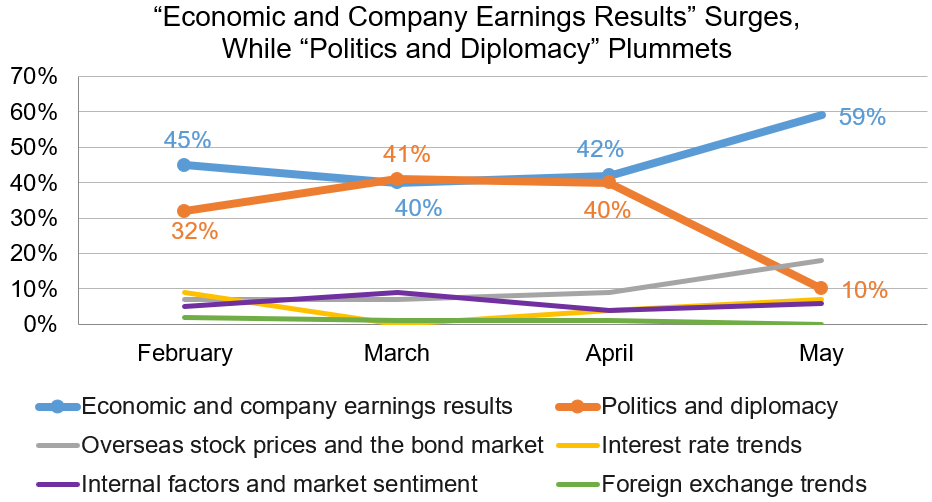
The survey was conducted from May 12 to 14. Responses were obtained from a total of 115 individuals, including those from securities firms and investment trust management companies. In a question about the most closely watched factors driving stock price volatility over the next six months, “Economic and company earnings results” rose sharply from 42% in the previous survey to 59%. The figure marked the highest level in seven months since October 2025 at 63%. As the announcement of financial results for the fiscal year ending March 2026 gets into full swing, the attention of market participants is shifting to individual corporate earnings. Meanwhile, “Politics and diplomacy” dropped sharply from 40% in the previous survey to 10%, the lowest level since September 2024, when it stood at 9%. Although crude oil prices remain high, this trend suggests that the market has for now priced in the turmoil in the Middle East. One respondent who selected “Economic and company earnings results” as a key factor to watch offered a bullish outlook. The respondent stated, “We anticipate an easing of tensions in the Middle East, which should reduce uncertainty about the future and lead to a downward trend in crude oil prices. Under these circumstances, the economic recovery and growth in corporate earnings are expected to continue, and the upward trend in stock prices is likely to persist.”
However, market participants no longer seem to be entirely bullish on the outlook for Japanese stocks. When asked how they viewed the current stock price level after the Nikkei 225 reached the JPY60,000 range, the largest share of respondents, at 49%, answered that it is a “reasonable level.” “Already overvalued level” followed at 41%. The response, “still undervalued level,” remained at only 10%. Another respondent expressed the view, “While there is caution regarding signs of overheating, investors feel strong psychological pressure to keep up with the market to some extent as long as the rally continues.”
Such investor sentiment can also be seen in the concentration of buying choices. The Nikkei 225 recently hit a new high, driven by concentrated buying in certain sectors, such as AI and semiconductor-related stocks. On the other hand, stocks with a heavy weight in the TOPIX, such as banks and automakers, are noticeably lagging behind. In fact, TOPIX, which covers a broader range of stocks compared to the Nikkei 225, has been unable to surpass its record high set on February 27, 2026. The NT ratio is calculated by dividing the Nikkei 225 by TOPIX. A higher ratio indicates that the Nikkei 225 is relatively stronger than TOPIX. This ratio has been hovering at a record high of around 16 times, meaning that the Nikkei 225 remains dominant. A different respondent pointed out, “For better or worse, the Nikkei 225 is no longer an index that reflects the entire Japanese economy. The impact of AI-related stocks has become extremely large. Furthermore, price movements of a handful of stocks often exert a significant influence on the index.”
Regarding TOPIX stocks that show strong signs of lagging, some voices in the market note, “Many of these are domestic demand-related stocks in Japan. With the impact of high crude oil prices and inflation on corporate earnings still unclear, it is difficult to justify buying them.” That said, as of May 18, the announcement of financial results for the fiscal year ending March 2026 by major companies has run its course. Consequently, many market observers view the revealed earnings outlook for the current fiscal year positively, with a strategist at a Japanese investment trust management company noting that the results are “not as bad as expected.” The future of the situation in the Middle East remains unpredictable. U.S. crude oil futures continue to stay high at around USD100 per barrel. For Japanese stocks to aim for further gains, crude oil prices must calm down alongside the resolution of the Middle East situation. In addition, the key will likely be whether a broader expansion of buying interest emerges, such as investment returning to the lagging TOPIX stocks.
(Reported on May 19, 2026)
QUICK Monthly Survey:
https://corporate.quick.co.jp/data-factory/en/product/data012/
Related article:
QUICK Monthly Survey: LDP’s Landslide Victory Boosts Growth Hopes, but Fiscal Concerns Linger
Disclaimer:
https://corporate.quick.co.jp/en/terms/#disclaimer
PPIH (7532) Aims for JPY4 tn in Sales through Its New Business Format, “Robin Hood”
JINSHD (3046): Stock Surges as a “Summer Stock,” Aiming to Become a Global Brand
Follow us on LinkedIn to stay updated with Japan Markets.