
Japan Markets ViewCan Sony Group’s CMOS Sensors Win as the “Eyes” in AI Era?
Jun 29, 2026

[Chiaki Yumi, QUICK Market Eyes] The stock price of Sony Group (6758) has been hovering near its year low. While the company is strengthening its identity as an entertainment enterprise, it has been overlooked by investors in the stock market dominated by artificial intelligence (AI).
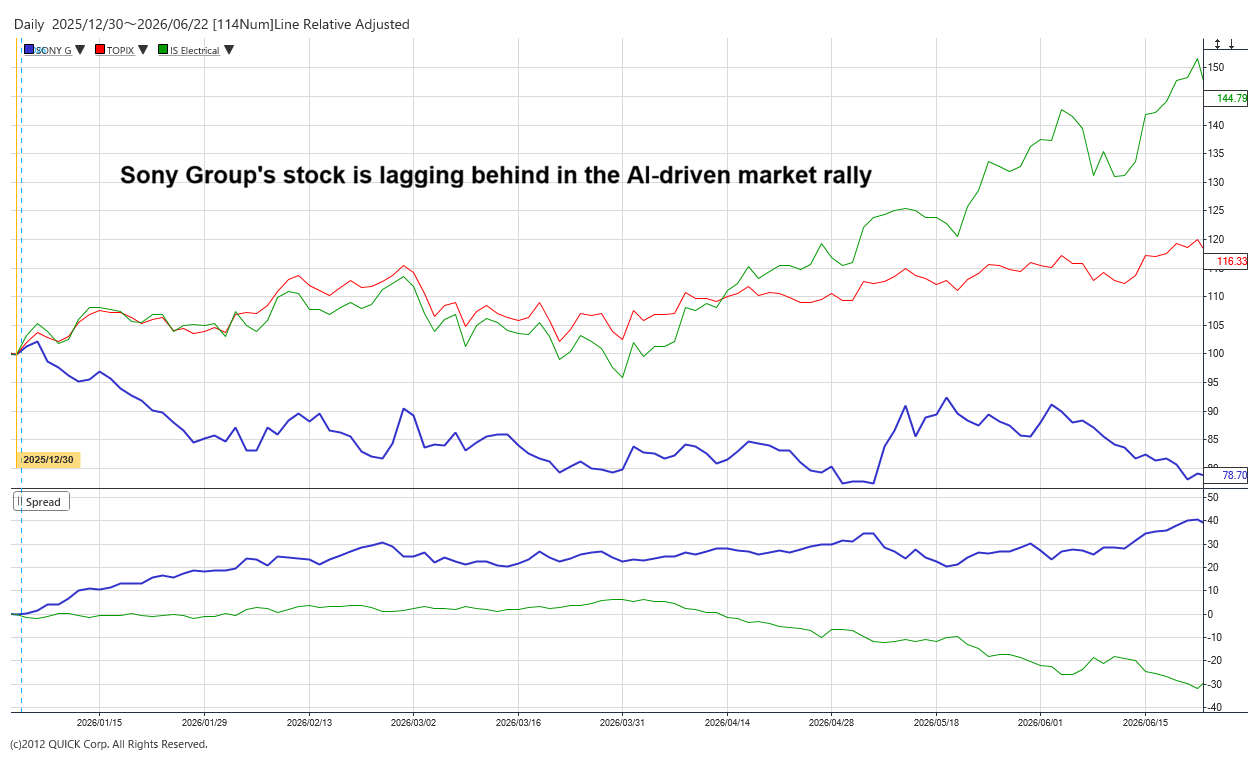
However, the complementary metal oxide semiconductor (CMOS) image sensors produced by Sony Group have the potential to become a game changer in the AI field. Graphics processing units (GPUs), which play a leading role in the AI era, serve as the “brain” that recognizes images. In contrast, CMOS sensors act as the “eyes” if compared to the human body.
They have conventionally served as “eyes” in digital cameras and smartphones. As smartphones become more advanced and increasingly incorporate AI capabilities, “eyes” that can capture objects in finer detail are becoming crucial. Consequently, high-performance CMOS sensors are currently in high demand. In the consolidated financial results for the fiscal year ending March 31, 2026, under IFRS Standards, the operating income of the Imaging & Sensing Solutions (I&SS) segment, which handles this business, was JPY357.3 bn, up 37% from the previous fiscal year. For the fiscal year ending March 31, 2027, the company plans to increase operating income to JPY400.0 bn, up 12% year-on-year.
Although their primary applications are currently in cameras and smartphones, CMOS sensors have the potential to increase their presence as the “eyes” of AI. In the field of “Physical AI,” where machines make autonomous decisions to perform tasks, superior “eyes” are indispensable for such operations.
However, “eyes” alone can do no more than project images of objects. When compared to the human body, the following elements are required to construct Physical AI. First, GPUs serve as the “brain” to learn tasks. Next, “eyes” are needed to grasp the situation. Accelerators function like the “visual cortex” to process information obtained from the eyes. Data communication networks act as “nerves” to transmit tasks to the body. In addition, “speed reducers” act as joints to control movement, and “motors” serve as muscles. Currently, investor interest is thriving for GPUs, memory semiconductors like DRAM and NAND involved in storage, and “physical” parts such as speed reducers and motors. In contrast, the level of attention given to the “eyes” as a sensory organ remains relatively low.
Nonetheless, there is a strong possibility that the importance of the “eyes” will be reassessed once the era of Physical AI arrives. One reason is that, depending on the task, the accuracy of information captured by CMOS sensors is highly likely to significantly influence the outcome. The second reason is the deployment as “Edge AI,” which operates directly on devices rather than in the cloud.
Although the tasks to be handled by Physical AI involve autonomous decision-making, they may primarily consist of repetitive motions. Furthermore, Physical AI is expected to be installed in a massive number of devices across factories and logistics warehouses. If all decisions depend on cloud-based GPU servers, communication costs and power consumption will surge. The cost burden grows heavier as the number of installed units increases. Therefore, the importance of Edge AI, where devices make on-site decisions, is highly likely to increase. Applying this to Sony Group, if CMOS sensors acting as “eyes” possess Edge AI capabilities for autonomous decision-making, routine tasks can be executed immediately based on the judgment of the “eyes.” For ambiguous cases, the system can query the “brain” in the cloud, thereby enabling this division of labor. This approach can reduce the load on GPU servers. It can also lower data traffic and power consumption.
In the future, as Physical AI shifts to the implementation stage, demands for economic rationality will likely become even more stringent. Anticipating this trend, Sony Group aims to make CMOS sensors smarter by embedding AI directly into image sensors. A prime example is the “IMX500” announced in 2020. In addition to the conventional CMOS function of “capturing images,” this sensor also possesses features to “detect people” and “classify objects.”
Future CMOS sensors are moving toward enhancing their value by closely integrating image-processing accelerators and memory. The partnership with TSMC, announced in May, is likely aimed at making CMOS sensors “smarter” by leveraging advanced packaging and stacking technologies.
Naturally, even if CMOS sensors become smarter, the importance of GPUs and memory will not decline. Currently, some views remain skeptical about whether the importance of CMOS sensors will truly increase. However, the development of Physical AI will progress further. In addition, competition will eventually shift from maximizing GPU performance to an era that prioritizes cost-efficiency, focusing on making systems affordable. When that era arrives, Sony Group, which is currently left out of investor interest, could attract attention as an AI-related stock, a potential future we should keep an eye on.
(Reported on June 24, 2026)
Discover datasets unique to the Japanese equity market
Visit QUICK Data Factory: https://corporate.quick.co.jp/data-factory/en/
Disclaimer
https://corporate.quick.co.jp/en/terms/#disclaimer
Follow us on LinkedIn to stay updated with Japan Markets.