
Japan Markets ViewDepartment Store Stocks Show Notable Gains: Driven by Inbound Tourism and Expanding High-End Consumption
Jul 03, 2026
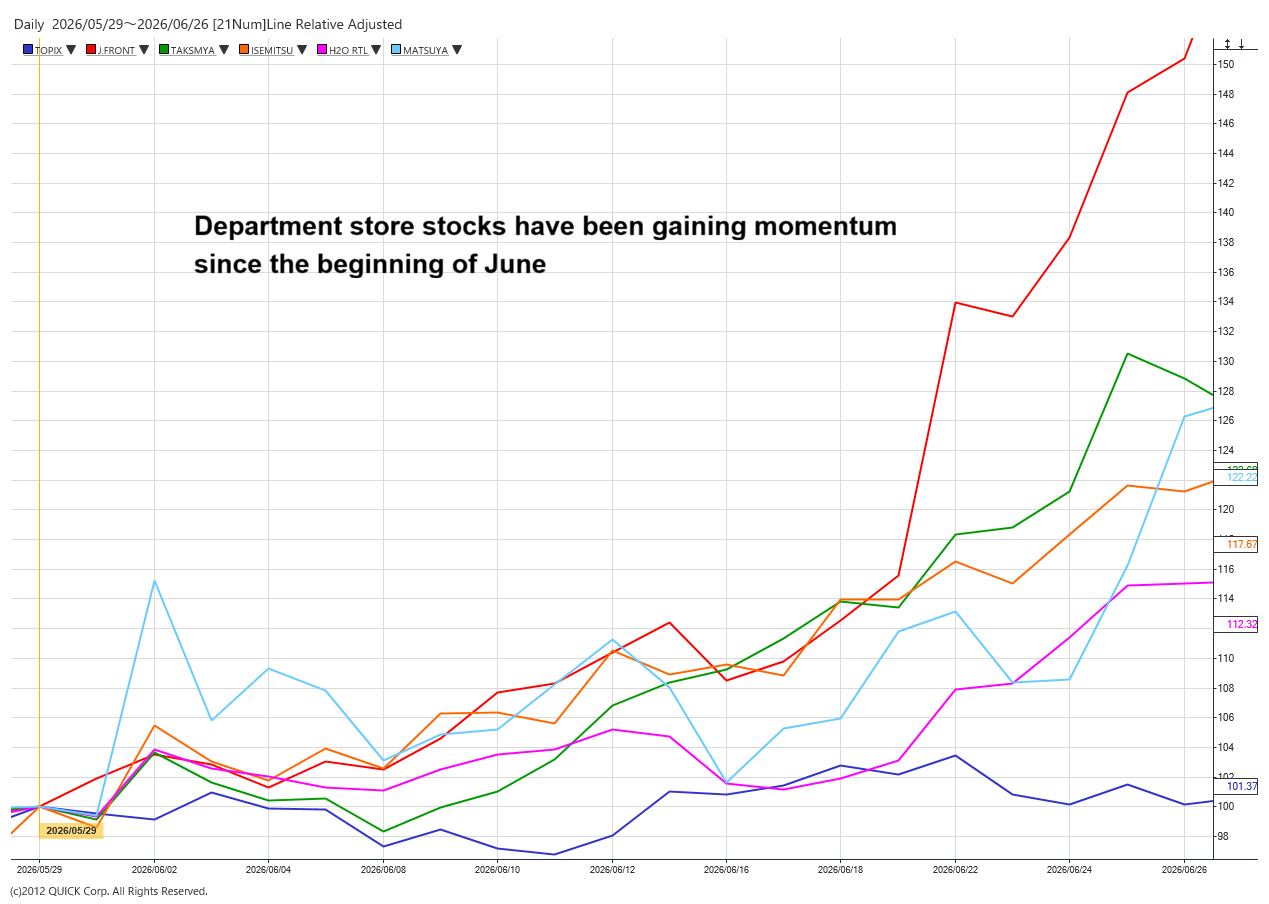
[Chiaki Yumi, QUICK Market Eyes] In the foreign exchange market, the yen is becoming normalized in the JPY160 range. Although the Bank of Japan (BOJ) is raising interest rates, they remain low by global standards. As currency interventions lose their effectiveness, this level appears to be becoming the “new normal.” Based on past empirical rules, this situation would typically lead investors to seek export-related companies such as automotive stocks. However, the notable gainers this time around are department stores linked to inbound tourist consumption. Expectations for the expansion of high-end consumption are rising, backed by the wealth effect from the recent stock rally.
Recent department store sales are robust. According to data from the Japan Department Stores Association, sales to Japanese customers have exceeded the previous year’s levels since the beginning of this year. Tax-free sales have also surpassed the previous year’s levels since March. Factor analysis shows that the number of purchasers is below the previous year’s level. However, an increase in the average spending per purchaser is driving overall growth. Demand appears to be shifting not only to low-unit-price products such as cosmetics but also to luxury brands and high-ticket items.
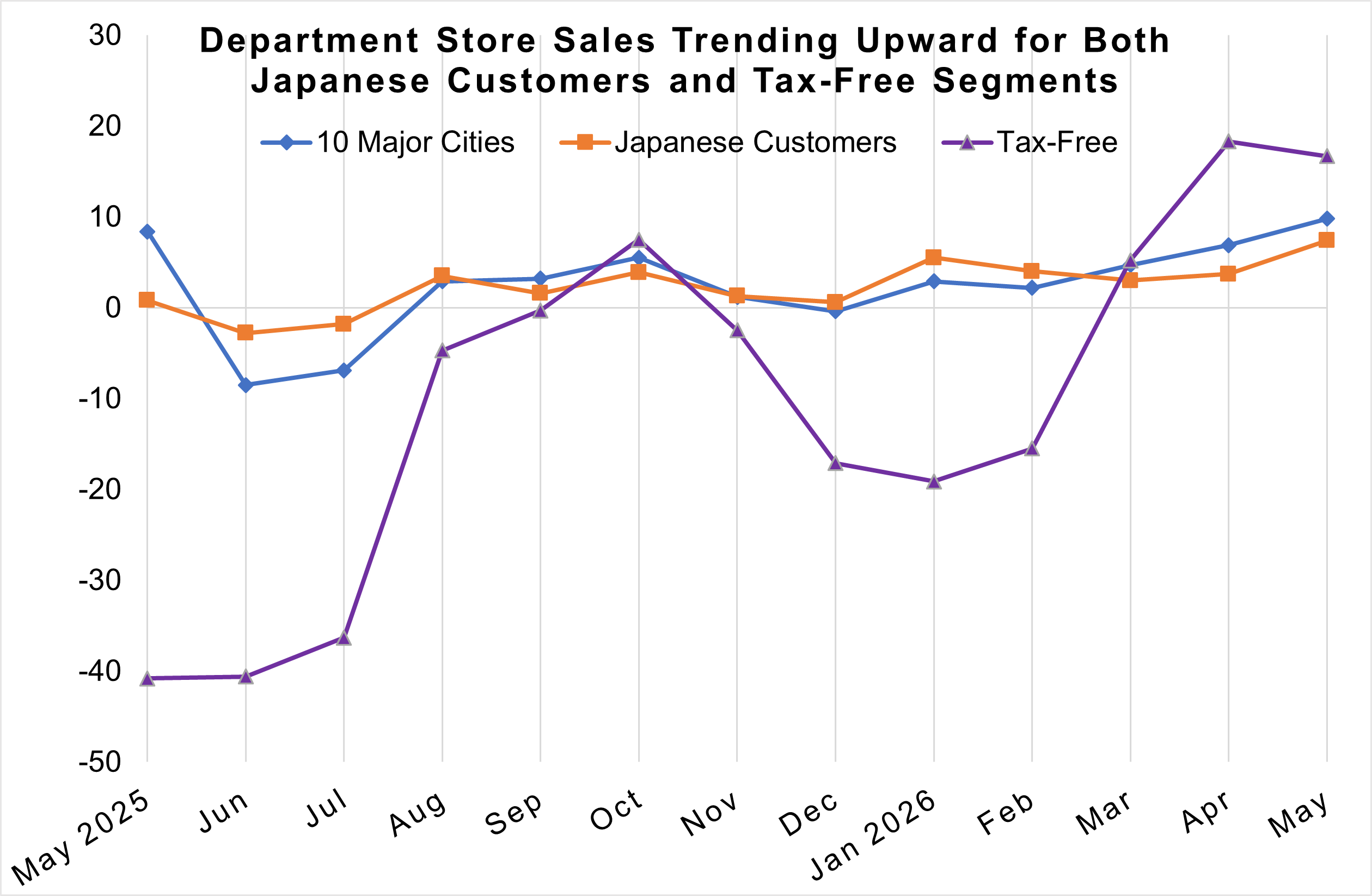
*Created based on data released by the Japan Department Stores Association. Year-on-year change, %. The 10 major cities are Sapporo, Sendai, Tokyo, Yokohama, Nagoya, Kyoto, Osaka, Kobe, Hiroshima, and Fukuoka.
For Japanese customers, the wealth effect from the recent stock rally is boosting sales. Luxury brands, jewelry, and watches are driving this growth. Looking at trends by product category, “personal goods,” which include luxury brand goods, have maintained revenue growth for five consecutive months. In addition, “art, jewelry, and precious metals” have sustained growth for 10 consecutive months. Both categories have high unit prices, and it is worth noting that their contribution is growing.
Department store stocks are not the only ones tapping into the boom in luxury consumption, whether from inbound tourists or Japanese customers. This strong momentum is particularly prominent among Japan’s leading watchmakers. Stock prices for Seiko Group (8050), which offers “Grand Seiko” and other brands, are near their year highs. Similarly, Citizen Watch (7762), which features the high-end “ATTESA” series, is also seeing its stock price reach similar heights.
Consumption Base Fails to Expand; Spending Polarization Becomes Clear
However, strong high-end consumption does not necessarily imply robust overall consumption. Rather, it should be viewed as a clear sign of growing polarization. Consumption remains strong among the wealthy, whose assets are increasing through high stock prices. On the other hand, rising prices are impacting daily necessities, and consumers are likely to hold back on non-essential spending. There is a stark contrast between the composite indices of high-volume, low-margin discount stores and major department stores.
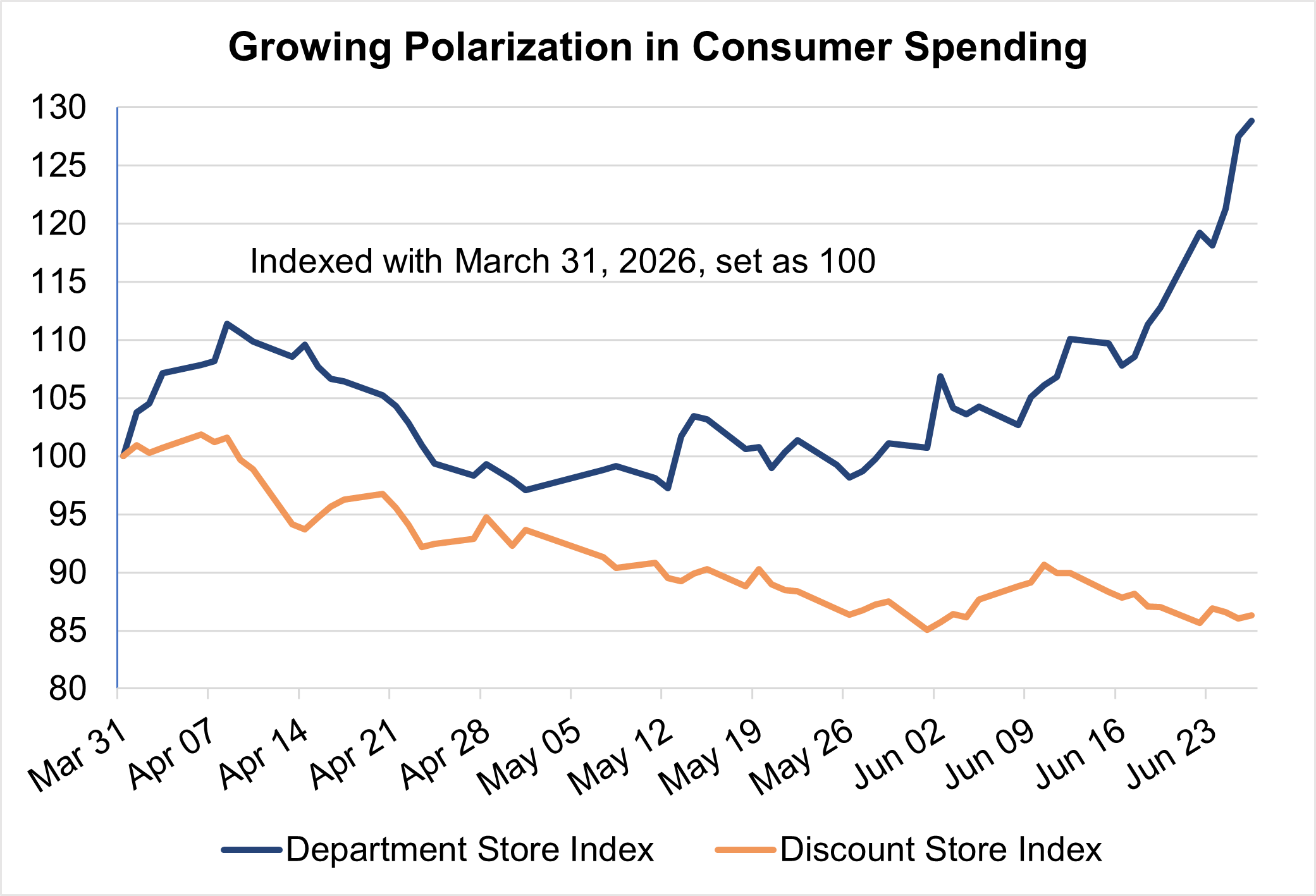
*The composite indices are created by calculating the simple average of stock prices for five major department stores and five discount stores. The department stores consist of Isetan Mitsukoshi Holdings (3099), J. Front Retailing (3086), Takashimaya Company (8233), Matsuya (8237), and H2O Retailing (8242). The discount stores comprise Mr Max Holdings (8203), Kobe Bussan (3038), Pan Pacific International Holdings (7532), SUNDRUG (9989), and Daikokuten Bussan (2791).
In fact, according to data from the Japan Chain Stores Association, which mainly tracks daily necessities, sales in May increased by 2.9% year-on-year on a store-adjusted basis. However, the impact of rising prices was significant, and the number of purchased items fell below the previous year’s level, particularly for food products. In the upcoming full-scale earnings announcements of retail companies for the March–May period, the distinction between “winners and losers” is expected to become even more pronounced.
(Reported on July 1, 2026)
Discover datasets unique to the Japanese equity market
Visit QUICK Data Factory: https://corporate.quick.co.jp/data-factory/en/
Disclaimer
https://corporate.quick.co.jp/en/terms/#disclaimer
Can Sony Group’s CMOS Sensors Win as the “Eyes” in AI Era?
The Second Stage of TOPIX Revisions Approaches: Number of Constituents May Fall Below 1,000
Follow us on LinkedIn to stay updated with Japan Markets.