Japan Markets ViewJapan Restaurant Stocks Rise on Expectations of Support Measures for Food and Beverage Tax Cuts
Nov 10, 2026

[Wataru Ueno, QUICK Market Eyes] According to various media reports, a bill to lower the consumption tax rate on food products from 8% to 1% for two years starting in April 2027 is expected to pass the House of Representatives as early as today in Japan (as of November 6). The bill has raised concerns about headwinds for the restaurant industry. However, restaurant stocks are seeing buybacks driven by expectations for government support measures. Meanwhile, some market participants note that it will be difficult for support measures to fully offset the decline in customer traffic. They believe it could negatively affect monthly same-store sales. The sustainability of the stock price recovery will likely depend on each company’s business format and branding strength.
On October 16, reports emerged that the government is considering effective support measures. These include premium gift certificates and initiatives similar to the “Go To Eat” campaign, a demand-stimulating program launched during the COVID-19 pandemic. Some observe that restaurant stocks are well positioned to absorb capital flowing out of consolidating AI and semiconductor stocks. Consequently, many restaurant stocks have moved against the broader market trend to post gains. Looking at stock price fluctuation rates from October 15 to November 5, SRS Holdings (8163), which operates Japanese restaurant chains such as “Washoku Sato,” rose 28.38%. Saizeriya (7581) gained 23.69%. Steakhouse chain Asakuma (7678, Standard Market) climbed 22.09%. Coffee chain Doutor Nichires Holdings (3087) increased 18.7%, and Yoshinoya Holdings (9861) rose 16.11%. All posted counter-trend gains against the 4.96% decline in the Nikkei 225.
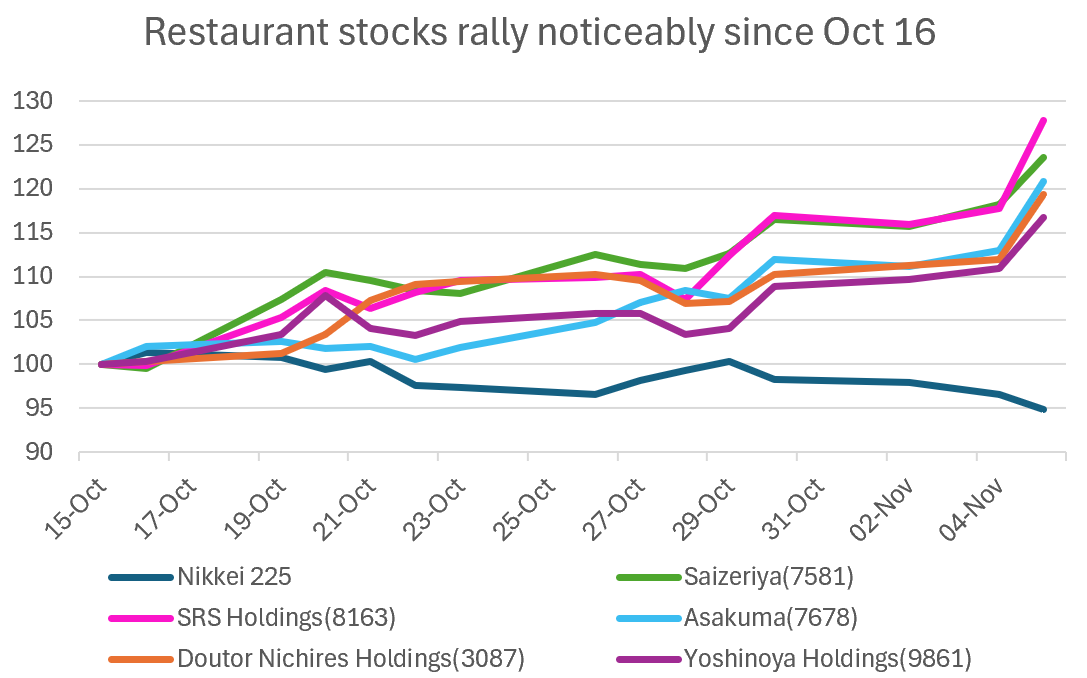
*Compiled from QUICK data. Relative stock prices indexed to October 15 closing prices as 100.
For SRS Holdings, Kyotaru – an operator of takeout sushi outlets and conveyor-belt sushi restaurants – began contributing to monthly sales in September. Additionally, the impact of price hikes at Washoku Sato has heightened expectations for strong business performance. Saizeriya also had its own catalysts for gains. The company raised prices on October 29 for the first time in about six years, fueling optimism for improved profitability.
Meanwhile, some market watchers point out that it will take time for consumers to get used to the price gap between eating at home and dining out. Support measures for the restaurant industry alone are unlikely to fully prevent consumers from cutting back on dining out. Consequently, some impact on customer traffic is expected. Ryotaro Sawada, senior analyst at Tokai Tokyo Intelligence Laboratory, pointed out, “If a drop in customer traffic becomes apparent in monthly same-store sales, stock prices could fall.” Sawada believes the negative impact of the consumption tax reduction on food and beverages will vary by business format. He noted, “Formats like Asakuma, which are often used for special occasions, have difficulty adapting to takeout, and a decline in customer traffic is likely to take a toll.”
Concrete proposals to support the restaurant industry have not yet emerged. Currently, market expectations are running ahead of reality. The forecast P/E ratio for the five top-gaining stocks – based on closing prices on November 4 – significantly exceeds the average of 15.44 times for companies listed on the Prime Market. Even Doutor Nichires Holdings, which has the lowest valuation among the five, stands at 21 times, while Asakuma trades at a high level of 114.4 times. These valuations can be seen as reflecting a rebound from the overconcentration in AI semiconductor stocks as well as solid recent same-store sales. However, these stocks have been bid up to levels that will be difficult to justify unless each company sustains high growth rates.
Nonetheless, expectations remain that restaurant stocks could rise further depending on the demand-stimulating measures to be rolled out by the Sanae Takaichi administration. Facing the headwind of consumers dining out less, corporate strategies will likely separate winners from losers in stock performance. Crucial factors include how successfully each company can capture home-dining demand through takeout, and how effectively it can appeal to consumers with dining experiences that can only be enjoyed when eating out. Investors should carefully assess policy effectiveness and risks to earnings. They should make investment decisions from a broad perspective, taking into account individual business performance trends and investment metrics such as the P/B ratio and P/E ratio.
(Reported on November 6, 2026)
Related dataset
Monthly Sales & Business Activity Data: Various corporate performance data in addition to monthly sales
Discover datasets unique to the Japanese equity market
Visit QUICK Data Factory:https://corporate.quick.co.jp/data-factory/en/
Disclaimer
https://corporate.quick.co.jp/en/terms/#disclaimer
Follow us on LinkedIn to stay updated with Japan Markets.